
Data-Driven Seismic Demand Estimation and Environmental Impact Assessment of Cross- Laminated Timber (CLT) Structures
Synopsis
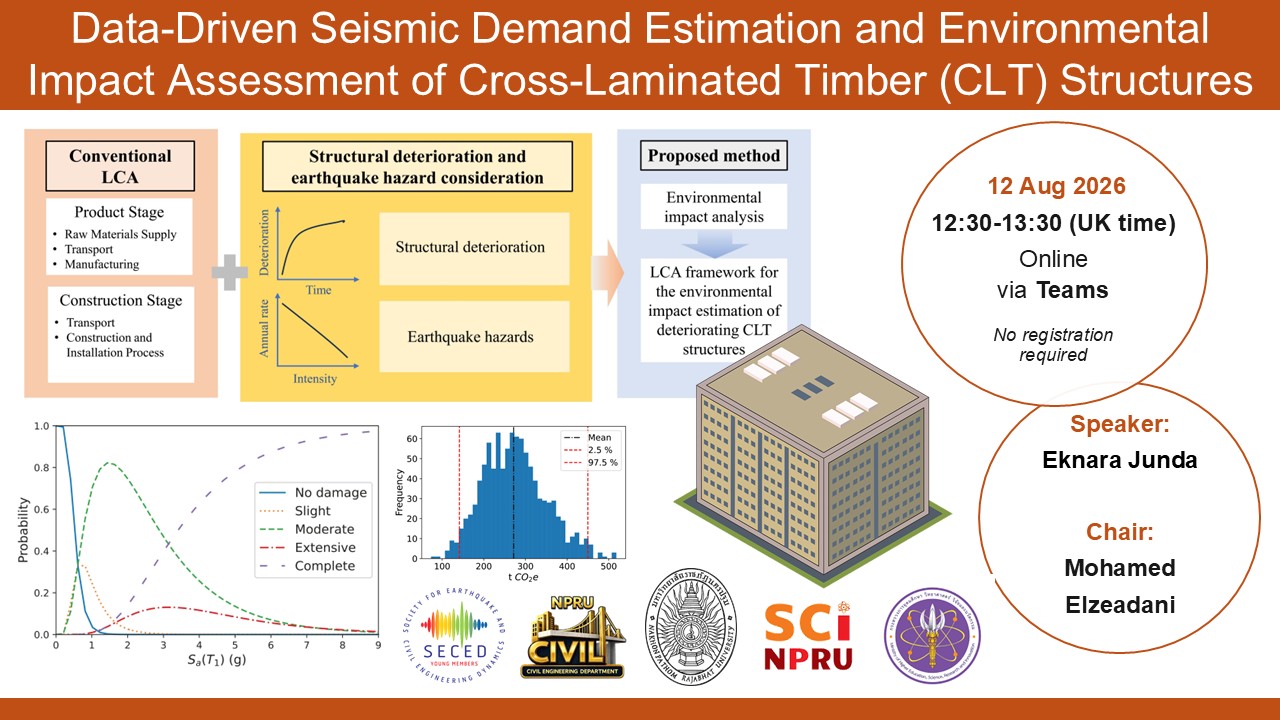
The global push toward sustainable urbanization has accelerated the adoption of mass timber, such as cross-laminated timber (CLT). However, building resilient cities requires balancing environmental benefits with robust seismic performance. Standard analytical frameworks often struggle to efficiently capture the complex, non-linear cyclic behavior of CLT connections under seismic loading, while traditional life-cycle assessments (LCAs) rarely account for earthquake-induced damage states. This talk presents an integrated, data-driven framework designed to bridge the gap between advanced structural performance and environmental impact assessment for CLT buildings. The presentation is divided into two core phases:
•Data-Driven Seismic Demand Estimation: We explore the application of machine learning (ML) models to predict critical structural responses—specifically, inter-story drift demands (governing structural damage) and floor acceleration demands (governing non-structural components and contents damage). By leveraging large databases of non-linear time history simulations, we demonstrate how ML algorithms can bypass computationally expensive numerical models to deliver rapid, highly accurate demand estimates across diverse seismic scenarios.
•Next-Generation Environmental Impact Evaluation: Moving beyond traditional LCAs, this section evaluates the seismic environmental footprint of CLT structures. We present a framework that integrates life-cycle assessment with performance-based earthquake engineering (PBEE) methodologies. This allows us to quantify the expected post-earthquake environmental impacts, such as the carbon cost of repairs and material replacement, providing a true reflection of a building’s life-cycle sustainability in seismically active regions.
About the speakers
Dr. Eknara Junda is a civil engineer specialising in structural engineering, particularly in seismic response and timber structures. He pursued his PhD at Imperial College London, focusing on AI applications for estimating the seismic response of timber buildings. He is currently an Assistant Professor at Nakhon Pathom Rajabhat University, where he continues his work in structural engineering and academia. He is also a member of the Earthquake Research Center of Thailand (EARTH), where he contributed to advancing earthquake risk assessment and disaster preparedness in Thailand. Dr. Junda specializes in structural and seismic engineering, with a focus on RC, steel, and timber buildings, as well as advanced structural systems. His expertise includes analysing dynamic responses of buildings under seismic loads and optimizing structural designs. He integrates traditional engineering practices with AI to predict and improve the seismic performance of buildings, advancing innovative solutions in modern construction and earthquake resilience.
Registration
The event is open to all and is free to attend. Please join the meeting via Teams* by clicking on this link. No registration is required.
Further information
This online talk is organised by SECED Young Members. For further information, please contact Mohamed Elzeadani (
* Microsoft Teams is freely available on all major platforms, including Windows, Linux, MacOS, Android and iOS. To download and install the software, follow this link. SECED is not sponsored by or otherwise affiliated with Microsoft, and we do not endorse any Microsoft products.
Event Details
| Event Date | 12/08/2026 12:30 pm |
| Event End Date | 12/08/2026 1:30 pm |