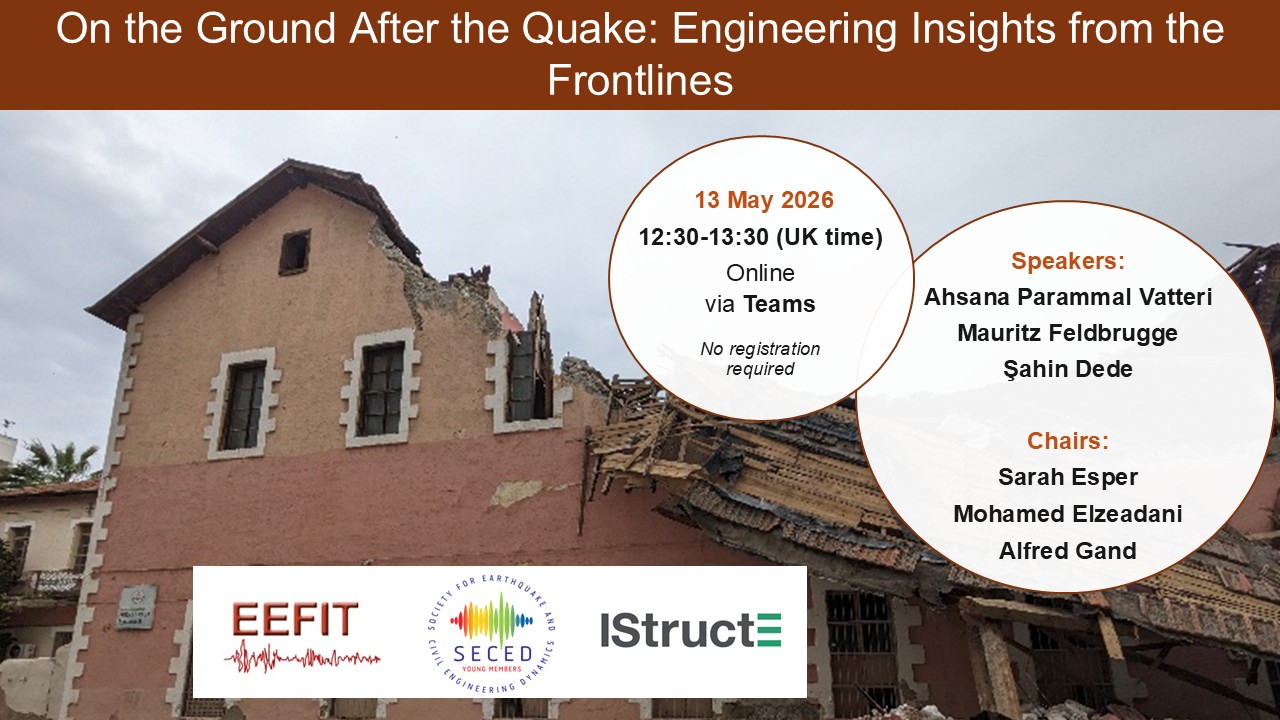
On the Ground After the Quake: Engineering Insights from the Frontlines
Synopsis
Talk 1 (Dr. Ahsana Parammal Vatteri): This talk reflects on my experience participating in two Earthquake Engineering Field Investigation Team (EEFIT) missions: the hybrid reconnaissance following the Aegean Sea earthquake and tsunami in 2020 and the in-person field mission to Turkey after the 2023 Turkey–Syria earthquakes. Through these contrasting deployments, I explore how different reconnaissance approaches shape the way we gather, interpret, and communicate post-disaster data. The hybrid mission highlighted the importance of digital tools, coordination across distributed teams, and working with secondary data sources, while the field mission emphasized rapid damage assessment, situational awareness, and engagement with affected communities and local experts. Drawing on both experiences, I would reflect on how my background was helpful in each context and I will discuss the key lessons learned, including the trade-offs between the two approaches.
Talk 2 (Mauritz Feldbrugge): How does a background in geo-engineering lead to the front lines of disaster response? Join Mauritz Feldbrugge as he recounts his deployment to Morocco following the 2023 Al Haouz earthquake. As part of the EEFIT mission, Mauritz investigated earthquake-induced landslides using a blend of remote sensing and traditional field mapping. This talk explores the path from university to international mission work, highlighting how specialized technical skills are applied in high-stakes environments. Mauritz will share his key lessons learned and offer insights for early-career professionals and students interested in contributing to global humanitarian and engineering missions.
Talk 3 (Şahin Dede): In February 2023, a series of large-magnitude mainshocks and aftershocks caused unprecedented devastation in eastern and southeastern Türkiye and northern Syria. These events claimed tens of thousands of lives as a consequence of the widespread failures in the built environment, amounting to hundreds of thousands of houses in a state of severe damage or collapse. This talk focuses on first-hand field observations made across different parts of Türkiye in the aftermath of the February 2023 earthquakes. As an early-career researcher in earthquake engineering, I reflect on my personal experiences from multiple field missions and on what the field has told us engineers, one of the many actors integral to building a resilient environment under natural hazards.
About the speakers
Dr Ahana Parammal Vatteri is a post-doctoral research fellow at the UNESCO Chair, where she focuses on developing tools for disaster resilience of integrated systems, particularly the application of Bayesian Networks and Agent-based modelling for system resilience problems. She focuses on confined masonry typology of buildings, especially school buildings and the resilience of education and associated critical infrastructure She also acts as a Module Coordinator for undergraduate and postgraduate modules at UCL. Her other engagements include post-earthquake reconnaissance missions, taxonomy development for confined masonry school buildings (GPSS project for the World Bank), consultancy projects on seismic-safety assessment of schools, and delivering capacity building workshops and online courses.
Mauritz Feldbrugge holds a BSc and MSc from Delft University of Technology (TU Delft), specializing in Geo-engineering and remote sensing. He is currently a Research Associate at the Earth Observatory of Singapore (EOS-RS), where he focuses on producing damage and flood proxy maps for emergency responders and humanitarian organizations. He is passionate about bridging the gap between academic research and real-world disaster impact.
Şahin Dede is a structural engineer with a specialisation in extreme loadings. Presently, he is a PhD candidate at University College London, investigating the multi-hazard vulnerability of tunnel-form buildings to earthquake and fire hazards by integrating sophisticated numerical modelling, post-earthquake field assessments, and computational programming. His research experience also spans seismic design and assessment, real-time earthquake loss mapping, and catastrophe risk modelling.
Registration
The event is open to all and is free to attend. Please join the meeting via Teams* by clicking on this link. No registration is required.
Further information
This online talk is jointly organised by SECED Young Members, EEFIT, and IStructE Midland Counties Group. For further information, please contact Mohamed Elzeadani (
* Microsoft Teams is freely available on all major platforms, including Windows, Linux, MacOS, Android and iOS. To download and install the software, follow this link. SECED is not sponsored by or otherwise affiliated with Microsoft, and we do not endorse any Microsoft products.
Event Details
| Event Date | 13/05/2026 12:30 pm |
| Event End Date | 13/05/2026 1:30 pm |